
Jenny Phillips, Marketing • February 13, 2020
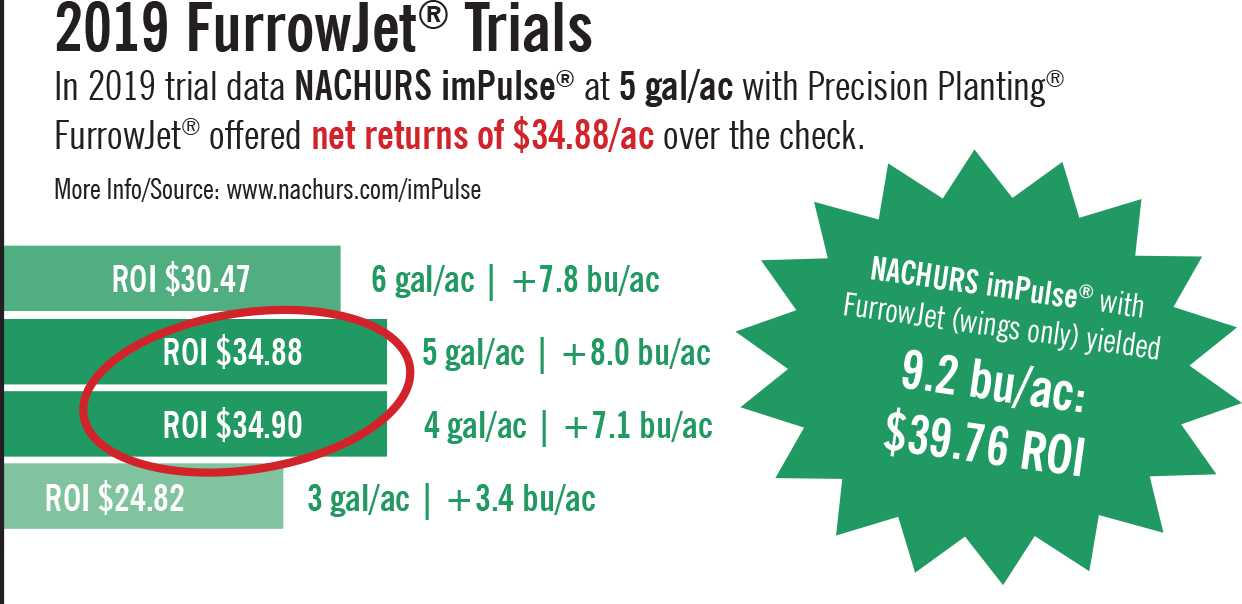
The results are in! Precision Planting® ranks NACHURS® BEST, again!

The FurrowJet® offers optimum starter placement: where seedling and crown roots can access the nutrients the best. When paired with NACHURS imPulse® liquid fertilizer, these technologies help maximize yield potential.
Contact your local NACHURS District Sales Manager today for more information. ASK US ABOUT:JD Financial @ FIXED 1.9% APR* • $6,000 Exclusive Equipment Rebate*
*Restrictions apply. See a NACHURS Sales Manager for details.
FurrowJet® and Precision Planting® are registered trademarks of Precision Planting LLC.
© 2020. NACHURS ALPINE SOLUTIONS. All rights reserved.

By Steve McQueen, Agronomy Manager, Nachurs Alpine Solutions.
When costs tighten, fertilizer decisions often shift toward reducing spend instead of protecting nutrient efficiency.

What importance does potassium and sulfur have on the plant?

The Crucial Role of Boron in Plants
February 6, 2025
The benefits of maximizing potassium efficiency

The benefits of Zinc on Winter Wheat
As I travel across Canada, it has been great to see moisture along much of my path. Greener pastures and ditches in Alberta, lush spring wheat, durum, and lentil crops in Saskatchewan, as well as many triticale, grass, and alfalfa fields, are being cut from British Columbia to Nova Scotia. I do not want to forget those potatoes spread across our country along with many specialty crops. As heat and moisture have brought germination, emergence, and vegetation growth, our crop nutrient management remains a key to success as we monitor the “Points of Influence.” Crop scouting, accompanied by tissue or sap samples, supports crop-based crop protection and foliar nutrient applications. As we have been programmed to concentrate on nitrogen, we are putting a lot of pressure on one nutrient to solve many deficiencies and concerns while ignoring the balance of fertility our crops may be looking for. In this blog post, I will not cover all the nutrient requirements but concentrate a little on magnesium, as I refer to what makes plants green. This spring, a significant amount of discussion surfaced around magnesium, and several growers requested magnesium for their cropping plans. Sometimes, what is new is old; looking back, magnesium has been a big part of many crop plans for decades. In sandy soils, specialty crops, and our high calcitic soils, we are looking to balance our oxygen and moisture space in soil levels. To better understand what we are looking at, I have included a list of what Mg is responsible for as well as soil activity stated: Magnesium Crops require magnesium to capture the sun's energy for growth and production through photosynthesis. Magnesium is an essential component of the chlorophyll molecule, with each molecule containing 6.7 percent magnesium. Magnesium also acts as a phosphorus carrier in plants. Necessary for cell division and protein formation. Phosphorus uptake could not occur without magnesium, and vice versa. Magnesium is essential for phosphate metabolism, plant respiration, and the activation of several enzyme systems.