AgroFocus Blog Series
Foliar Management
“Maximizing yield potential is all about providing soluble nutrient sources through contact with the plant during critical periods of growth, or in other words, empowering the crop ” Jay Castleman, NACHURS RSM US East.
With planting down to a few specialty crops across Canada, our focus is being redirected to build upon the foundation created by our “at planting” fertilizer programs!
As I reflect on my first blog and how important ground truthing is to our decision-making, I want to emphasize the importance of understanding the stages of your crops, plant uniformity, and health. As the headliner refers to your “at planting” fertilizer program, we may underestimate how a solid in-furrow phosphorous starter amplifies your foliar program.
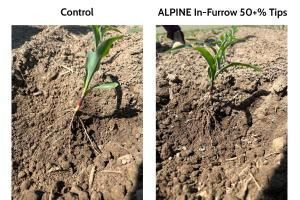
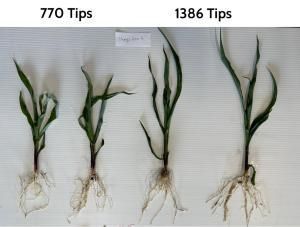
To further clarify the concept of setting plants up for success, the root photos taken from our plots show how a plant searching for phosphorous has fewer fibrous roots leading to fewer tips than the plant that has access to an available source, localized in the root zone. These fibrous root masses measure a significant increase in root tips, developing an early advantage in accessing soil moisture and nutrients. So, how does this relate to enhancing a foliar application?
With tissue or sap samples, we will now look at matching nutrient deficiencies with products that benefit health and efficiency. Referring to Jay’s statement, we want to empower our crops while maximizing yield potential. To empower our crops, we must better understand each point of influence and be prepared to apply nutrients that will amplify what the plant is naturally trying to accomplish in a timely fashion.
When matching nutrients to your deficiencies, you will want to make sure that you consider a balanced approach, including nutrients that synergize with each other. A carrier product that will create added value is where ALPINE Bio-K products are set apart. With the added value of potassium acetate, this highly soluble source of K, with a point of deliquescence, allows it to stay in the solution above 23% humidity. Being a plant metabolite, ALPINE Bio-K increases the metabolism of your crop, improving the uptake of the micronutrients required. To ensure we manage our resources to the best of our abilities, ALPINE has developed a line of foliar products to Maximize Fertilizer Efficiency .
As I wrap up, I need to refer to my statement, “So, how does this relate to enhancing a foliar application?” made earlier in the post. Foliar applications of plant nutrients are directed at plants and therefore are very efficient. Plants respond quickly to the nutrients applied, and as roots do not feed themselves, many foliar-applied nutrients are transferred to the root zone. The influx of nutrients to the root zone will increase exudates along with developing root growth, elongating each root tip. If a plant rises 50-75% more tips, it will have a much better opportunity to improve root-to-soil contact, increasing the uptake of available soil fertility. The nutrients retrieved from the soil will then quickly return to the plant and overcome the deficiency.
Let’s consider our foliar application as both a nutrient boost and a plant signal. We will improve our decision-making ability by better understanding how we utilize our entire cropping plan from Start2Finish .
-Steve McQueen, Agronomy Manager
Click on the images to view them.